
delina 2026: Award nominees illustrate innovative strength of the industry
LEARNTEC Innovation Award for Digital Education honours pioneering projects – More than 100 entries
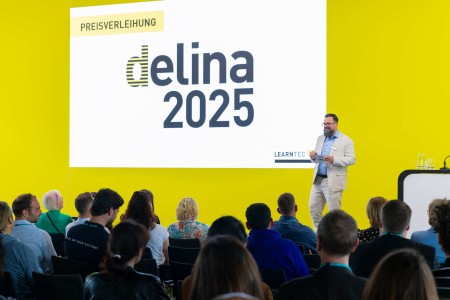
Artificial Intelligence, gaming and augmented reality: More than 100 submissions for the delina Innovation Award for Digital Education are undeniable proof of the industry's innovative strength. The jury has now announced the nominees in the four categories ‘Early childhood education and school’, ‘University, ‘Training and further education’ and ‘Society and lifelong learning’. The delina recognises outstanding projects in the field of digital education. The award ceremony will take place on May 7, 2026 as part of LEARNTEC at Messe Karlsruhe.
Research projects, educational institutions and companies: all share the common goal of rethinking learning by developing and transforming the advantages of digitalisation into sustainable learning opportunities. The following companies and projects have been nominated:
_9_6_450x300.jpg)
‘Early childhood education and school’
Debuff Interactive UG uses the puzzle game ‘Waste Sorting’ to teach skills for waste separation in Germany in a playful way, combining environmental education with the promotion of orientation and problem-solving skills.
‘TouchTomorrow Creator’, a project by the Dr. Hans Riegel Foundation, gives schoolchildren, especially those at schools with limited access to STEM programmes, practical and critical access to AI in order to strengthen future skills in a creative and low-threshold way.
With its ‘AI Compass Primary School,’ the Neue Grundschule Potsdam is developing a structured school development concept for the didactically sound integration of Artificial Intelligence in primary education, which systematically promotes self-regulated learning and anchors AI as a reflective learning partner in the classroom.
‘University’
With its digital learning tool ‘Brian’, Brian AG combines an AI teaching assistant for intelligent content creation with an adaptive, gamified learning interface, enabling individualised learning processes and transparent analytics across all subject areas.
The Hochschule für Polizei Baden-Württemberg strengthens the communication skills of police students with its video-based blended learning format ‘Projekt ProfisPOL’ (Project ProfisPOL), in which practical teaching videos complement classic role-play games, save resources and improve the quality of training in the long term.
With its ‘Educational Design Toolkit myScripting’, the ZHAW Zentrum für Innovative Didaktik has developed a web-based, freely available design tool that supports teachers in the scientifically sound planning of digital learning environments with integrated AI support and analytics, thus promoting the professional development of digital teaching skills.
‘Training and further education’
With its ‘Digital Learning Lab – Rethinking Learning in Public Administration,’ the Bayerische Verwaltungsschule has created an innovation space in which hybrid learning settings, AI applications and VR scenarios are systematically tested and established as catalysts for further development of the public sector learning culture.
Bahn 360 from Deutsche Bahn AG (DB Training, Learning & Consulting) is a digital experience world. It combines classic railway content with AI functionalities such as the BahnGPT chatbot and enables location- and time-independent further training for various target groups.
With ‘New Blended Learning with AI Skill Boost Agents’, Potenziale GmbH shows the potential success of modern personnel development: AI-supported simulations of real management meetings, workshops and peer exchanges allow participants to develop and strengthen communication skills.
‘Society and lifelong learning’
The Memorium Nürnberger Prozesse (Museums of the City of Nuremberg) uses ‘Tribunal 45 – Working on Justice’ to interactively convey the history of the Nuremberg Trials for major war criminals. Players interactively develop arguments and evidence in four phases of the trial, and deal with fundamental questions of international criminal law.
Together with the Kunsthalle Mannheim and the Kunstmuseum Stuttgart, Wegesrand GmbH & Co. KG has created ‘Vom Werk zum Display’ (From Work to Display), a digital education project that expands 22 works of art through interactive episodes, virtual overlays and narrative formats, thus making digital space an independent aesthetic experience.
With its ‘Geo-Spatial Agent,’ ZAUBAR UG turns real locations into AI-supported, dialogue-based learning experiences by displaying context-related explanations and 3D visualisations directly in the environment, thus creating low-threshold educational offerings for museums, cities and lifelong learning programmes.
Simon Dzierzawa, founder of gamelynk.io, received the coveted award last year for a shooter game that supports vocabulary training. He said: "This is a huge honour. You develop a game like this over a long period of time, quietly, in a lonely little room. So it's all the more surprising when you receive an award at such a big trade fair. We're definitely taking a huge dose of motivation with us today."